



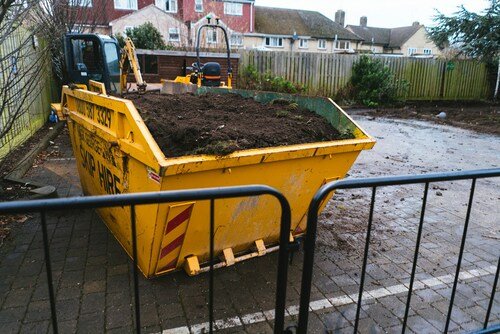
Most people only discover they needed a permit after the skip has already been delivered — and by that point, the options are limited and the costs can mount quickly.
If you’re organising skip hire in Ealing, understanding the local rules around placement and permits before you book will save you from unnecessary fines, failed deliveries and council enforcement. This guide covers the full picture: when a permit is required, how to apply, what alternatives exist and how to ensure your waste is handled legally and efficiently from start to finish.
Do you need a permit for a skip in Ealing?
The rule is straightforward in principle. If the skip will sit entirely on private property – a driveway, a forecourt or a private car park – no permit is required. The moment any part of the skip extends onto the public highway, pavement or verge, you need a permit issued by the local highway authority.
In practice, many Ealing properties – particularly terraced houses, purpose-built flats and older Victorian streets – have little or no off-street parking. That means on-street placement is often unavoidable, and a permit is therefore necessary. Don’t assume that a brief placement or a quiet side street means you can bypass the process. Councils do check, enforcement officers do patrol and the consequences of non-compliance are real and sometimes costly.
It’s also worth noting that some roads in Ealing fall under specific traffic management orders or conservation area restrictions, which can affect where and for how long a skip can be placed. If you’re unsure about your specific street, B&K can advise before you book – it’s a straightforward check that avoids complications later.
How to apply for an on-street skip permit in Ealing — step by step
Permits for on-street skip placement in Ealing are issued by Ealing Council’s highways department. The process involves submitting an application – typically online – with details of the proposed placement location, the intended duration of hire and the skip dimensions.
What information does the council need?
You’ll generally need to provide:
- The full address and precise location on the highway where the skip will sit.
- Intended delivery and collection dates.
- The name and licence details of the skip hire company.
- Confirmation that the skip will carry reflective signs and lights if left in place overnight.
Processing times vary, but allowing at least five to seven working days before your planned delivery date is sensible. Some applications are processed faster; others may require additional checks, particularly on busier roads, near junctions or in areas with existing traffic management orders. B&K can advise on the specifics for your location and, in many cases, assist with the permit application on your behalf – removing one more administrative task from an already busy project schedule.
Permit fees and duration
Permit fees are set by the council and are typically modest – a small, fixed cost for a defined period of placement. Extensions are possible but require a new application or an amendment to the existing one. If your project overruns and the skip needs to stay longer than permitted, notify B&K and the council promptly; an expired permit is treated the same as no permit at all.
The consequences of skipping the permit process
It’s tempting to think a skip sitting outside for a day or two won’t attract attention. In reality, councils and enforcement officers in Ealing do act on unpermitted skips. The skip can be removed at the owner’s expense, a fixed penalty notice can be issued and the skip hire company may also face liability for placing a container on the highway without authorisation.
Beyond the financial risk, an unpermitted skip causing an obstruction could restrict access for emergency vehicles – a serious matter with real legal implications for the property owner. The cost of a permit is modest compared to the potential cost of enforcement action. It is simply not worth the risk, and experienced local providers like B&K will always advise customers to obtain the correct permissions before delivery.
Practical tips for safe skip placement in Ealing
Whether on private property or the public highway, placement matters. A few practical points worth keeping in mind:
Place protective boards under the skip to prevent driveway or road surface damage – this is especially important on block paving, older tarmac or any surface that’s been recently laid. Ensure the skip doesn’t block visibility at junctions, obstruct dropped kerbs or restrict access to neighbouring properties. For overnight on-street placement, reflective markers and warning lights are a legal requirement and a basic safety measure.
Safe loading is equally important. Keep waste below the fill line at all times – an overfilled skip is unsafe in transit and will be refused for collection. Distribute heavy materials like bricks and concrete evenly across the base of the skip rather than piling them on one side. This improves stability during loading and transport.
Communicating with neighbours before delivery
This is a step many people skip – and it’s one of the most effective ways to avoid complaints. On narrow Ealing streets, a skip can significantly reduce available parking and restrict access for residents. A brief note through neighbouring doors explaining the delivery date, the expected duration and a contact number for queries costs nothing and prevents the kind of friction that can escalate into formal complaints to the council.
If your project involves multiple skip collections over several weeks, keep neighbours updated as the project progresses. A little communication goes a long way on busy residential streets.
Permit-free alternatives worth considering
Permits aren’t always the most practical route, particularly for short-term projects or properties with very limited road space. Two alternatives are worth knowing about before you commit to a standard skip.
Wait & load: the flexible no-permit option
B&K’s wait & load service involves a vehicle arriving at your property, waiting while you load the waste and then departing immediately. Because the vehicle doesn’t remain on the highway unattended, no permit is required. It’s a practical and often faster option for one-off clearances, tight access situations or projects where a static skip would cause too much disruption to neighbours or passing traffic.
For many Ealing homeowners tackling a single-room clearance, a post-renovation tidy or a quick garden clear, wait & load is both simpler and more cost-effective than arranging a traditional skip hire with permit. It also avoids the overnight lighting obligation and the risk of third parties adding unauthorised waste to your skip – a surprisingly common issue on busier streets.
Grab hire for heavy materials
Grab hire is another permit-free alternative for specific project types. A grab lorry arrives, loads heavy or loose materials directly using a hydraulic arm and departs – no static container left on the street. Particularly useful for landscaping projects, post-demolition clearances or any job generating large volumes of soil, hardcore or green waste. For Ealing homeowners undertaking significant garden work or ground excavation, grab hire is often the fastest and most economical solution.
Commercial skip hire and waste compliance in Ealing
For businesses, landlords and contractors operating in Ealing, waste compliance extends well beyond permit requirements. Commercial waste producers have a legal Duty of Care: waste must be handled by a licensed waste carrier, a waste transfer note must be obtained for every collection and records must be retained for a minimum of two years.